Happy Monday.
This Week’s Stories, Ranked:
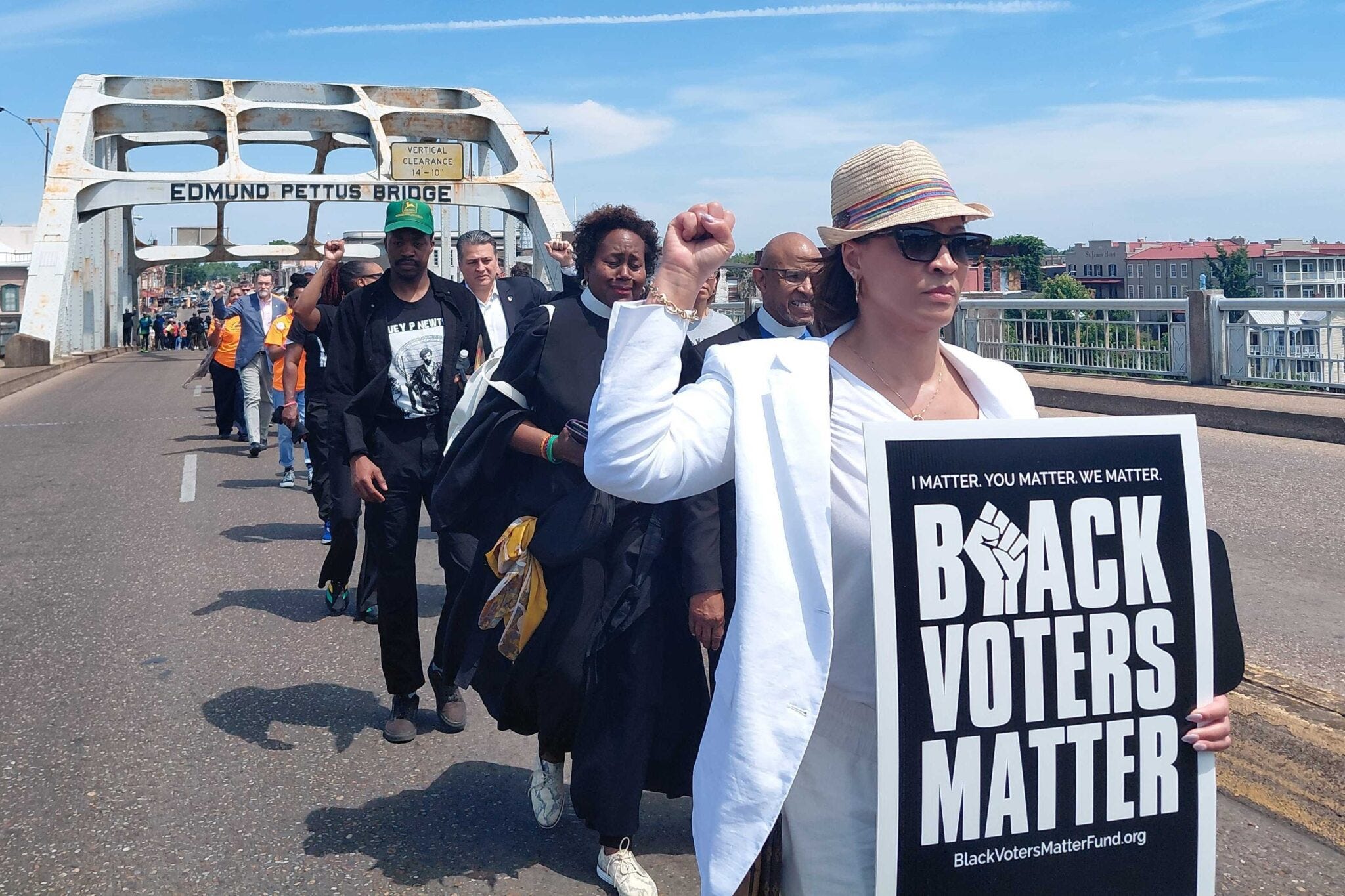
Over 5,000 people rallied in Montgomery on Saturday, with thousands more crossing the Edmund Pettus Bridge in Selma, in the largest voting rights demonstrations since the original 1965 marches. The “All Roads Lead to the South” campaign brought activists, clergy, union organizers, and members of Congress to Alabama’s sacred civil rights ground to protest the wave of redistricting that followed the Supreme Court’s 6-3 decision in Louisiana v. Callais. Rep. Alexandria Ocasio-Cortez told the crowd, “They think they can draw us out of power. They do not know the sleeping giant that they just awakened.” This week, a federal court holds a May 22 hearing on whether to block Alabama from using a congressional map it previously ruled racially discriminatory. Tennessee has already signed a new map carving up Memphis’s majority-Black district. Fair Fight Action estimates the Callais ruling could eliminate up to 19 majority-minority seats. This is the most significant rollback of Black political representation since Reconstruction, and this weekend people showed up to say they will not accept it quietly.
We are on day 80 of a war Congress never authorized, and today the president is allegedly sitting down with JD Vance, Marco Rubio, Pete Hegseth, CIA Director John Ratcliffe, and special envoy Steve Witkoff at his Virginia golf club to decide whether to restart the bombing. Axios reported Saturday that the Pentagon has prepared target packages for Iranian energy and infrastructure sites, and that options include resuming airstrikes against the remaining 25% of targets the military identified but hasn’t hit. Trump warned on Saturday that “there won’t be anything left of them” if Iran doesn’t move quickly on a deal. The ceasefire, declared April 8, has been violated by both sides repeatedly.
The World Health Organization declared that the Ebola outbreak in Congo and Uganda is a public health emergency of international concern. At least 88 people are dead and over 300 cases are suspected. The strain driving this outbreak is Bundibugyo, a rare Ebola species for which there is no approved vaccine and no specific treatment. The Boston Globe reported that the existing Ervebo vaccine is too expensive at nearly $99 per dose and requires ultra-cold storage that’s unavailable in rural Congo. Public health experts are pointing directly at USAID cuts as a reason the outbreak wasn’t caught earlier and the response capacity isn’t there. Before Trump dismantled USAID, the agency would have had people on the ground before an outbreak was even formally declared. Now there’s no surveillance infrastructure, no supply chain for lab equipment, and no protective gear pipeline for health workers.
The national average for a gallon of gas is $4.52 this morning, according to AAA, and WTI crude futures closed Friday above $106 per barrel after an 11% weekly gain. Gasoline prices are up 74% year over year. The Strait of Hormuz, through which roughly 20 million barrels of oil flow daily, has been effectively closed since early March. California is well past $6. Memorial Day is next weekend. Every Republican strategist I’ve read is panicking about this number, and the administration has no plan to bring it down.
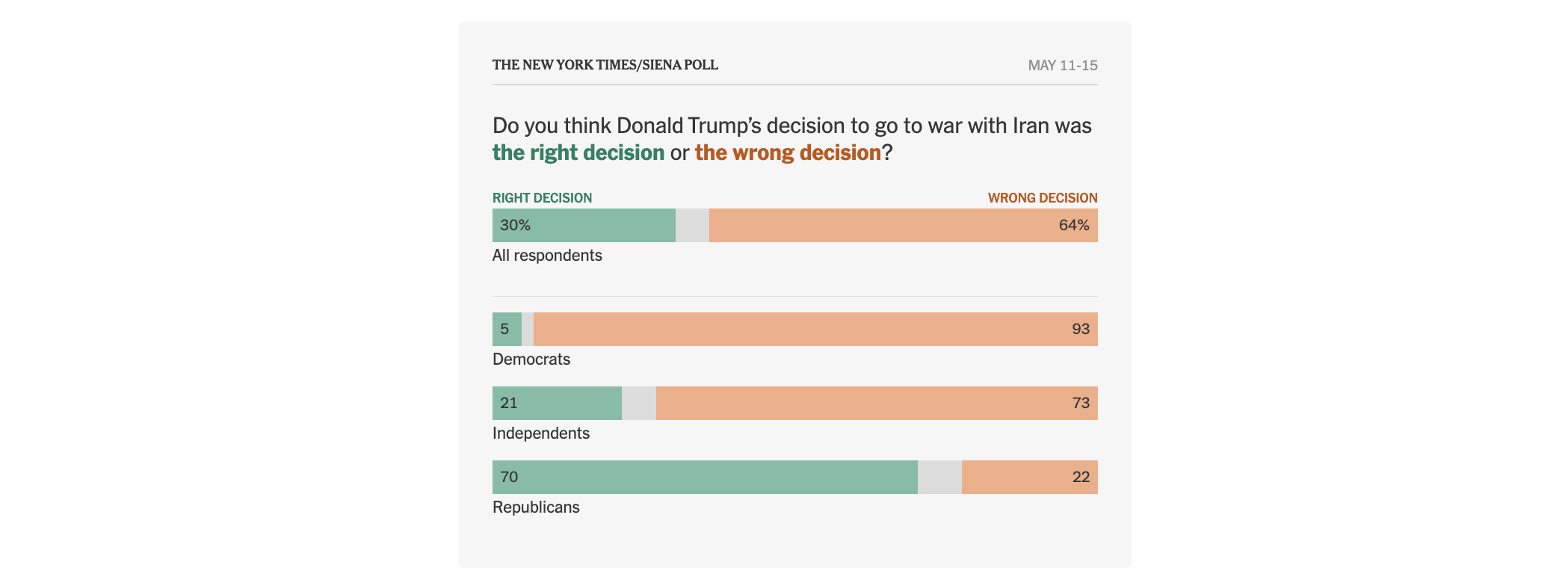
Trump’s net approval hit a new second-term low of -18.9 in the Silver Bulletin average as of Saturday, with approval at roughly 38% and disapproval approaching 60%. A recent New York Times/Siena poll found that 64% think that going to war with Iran was the wrong decision, including nearly three-quarters of independents. Forty-seven percent of independents said his policies had hurt them, up from 41 percent in fall 2025. The NYT poll found:
-
64% disapprove of his handling of the economy
-
69% disapprove on cost of living
-
49% rate the economy as “poor” (up 11 points since January)
-
Only 32% say the country is on the right track
-
63% say president shouldn’t use military force without congressional approval
-
73% of independents said the war was wrong
The Senate Judiciary and Homeland Security Committees are expected to mark up the $72 billion reconciliation package funding ICE and CBP on Tuesday and then send it to the floor. The text, released on May 4, would give ICE $38.2 billion, CBP over $26 billion, the Justice Department $1.5 billion for “terrorism prosecution,” and, tucked in on the last page, was $1 billion for Secret Service security upgrades to a new White House ballroom. The parlimentarian has removed it as non germane, however Republicans can go back to the Parlimentarian with updated language. If they do so, Democrats will have something called a vote-a-rama to draw significant attention to this unpopular money-grab on the floor of the Senate. Trump wants it on his desk by June 1, it has to pass the House after the Senate.
Trump returned from his two-day summit with Xi Jinping in Beijing on Friday with a “constructive” framework, a Boeing aircraft order smaller than promised, and no progress on Iran or Taiwan. The Washington Post reported that Xi got everything he wanted out of the meeting without giving any ground. Trump claimed “a lot of different problems” were settled, but no major agreements were announced. Xi warned that mishandling Taiwan would put the entire relationship in “great jeopardy,” and Trump has not said whether he’ll proceed with a planned arms sale to Taiwan. The next meeting is set for this fall, which is diplomatic language for “nothing happened.”
The House passed the Farm, Food, and National Security Act 224-200 on April 30, locking in $187 billion in SNAP cuts from the earlier reconciliation package. But the real drama heading into the Senate is the pesticide fight. Anna Paulina Luna led an amendment that stripped the bill’s liability shield for pesticide companies by a vote of 280-142, a massive MAHA win (though really a Democratic win) that enraged Big Ag. Other big supporters are Rep. Chellie Pingree (D-ME), who argued the original provision prioritized corporate profits over public health, and Rep. Thomas Massie (R-KY) who praised the change as a victory for state rights and MAHA. (The provision would have blocked farmers from suing companies like Bayer over cancers linked to glyphosate. Senate Majority Leader Thune has signaled he wants to put the pesticide protections back in the Senate version, prompting Anna Paulina Luna to publicly warn that if those protections come back, “we have the votes to kill it.” This puts MAHA squarely at odds with Trump and Senate Republican leadership. Meanwhile, 42 million Americans could see permanent reductions in food assistance. The Senate version needs 60 votes, which means Democrats have actual leverage on the SNAP cuts.
After cutting FEMA’s workforce from 29,000 to roughly 23,000, the administration is now scrambling to rehire disaster response staff it just let go, because hurricane season starts June 1. FEMA workers who were put on leave for raising concerns about national disaster preparedness have been reinstated after eight months after a lawsuit. House Democrats argued that “FEMA is less prepared to respond than it has been in a generation.” The administration’s own budget proposes slashing another $646 million from the agency.
The primary calendar is filling in, and the matchups are getting real. Here’s where things stand.
-
In Louisiana, Bill Cassidy lost his Senate primary on Saturday, knocked out by Trump-backed Julia Letlow (45%) and state Treasurer John Fleming (28%), who advance to a June 27 runoff. Cassidy, who voted to convict Trump during impeachment, got just 25%.
-
In Texas, James Talarico won the Democratic Senate nomination in March and is now polling ahead of both Republicans in the May 26 runoff between John Cornyn and Ken Paxton, which is statistically tied. A Democrat leading in Texas is not a sentence anyone expected to write.
-
In Ohio, Sherrod Brown won the Democratic primary on May 5 to take on Jon Husted, setting up one of the most closely watched rematches of the cycle.
-
In North Carolina, Roy Cooper and Michael Whatley won their respective Senate primaries for an open seat.
-
And in Louisiana, the House primaries that were supposed to happen Saturday were postponed entirely because the state is redrawing districts after the Callais ruling.
-
In Nebraska, Denise Powell won the Democratic nomination in NE-2, the Omaha-area “blue dot” district that went for Biden and Harris. She’ll face Republican Brinker Harding for the open seat after Don Bacon’s retirement, and this is one of Democrats’ top House pickup opportunities.
-
In West Virginia, Shelley Moore Capito won her GOP Senate primary easily, and she’ll face Democrat Rachel Anderson in November.
Nationally, Democrats need just three seats to flip the House, and the environment could not be worse for Republicans: $4.52 gas, an unpopular war, Trump’s approval in the basement, and the Callais gerrymandering backlash energizing Democratic voters in ways the GOP did not anticipate. The Selma march this weekend was not just about redistricting. It was an early preview of turnout energy.
Tuesday, May 19 at 2:00 PM: House Appropriations, Commerce/Justice/Science Subcommittee. Oversight hearing on the Department of Justice. Acting Attorney General Todd Blanche testifies. AG OVERSIGHT HEARING. Given the Pirro appointment, the Cole Allen prosecution, and the DOJ’s general posture this year, expect fireworks from both sides.
Tuesday, May 19 at 2:00 PM: Senate Commerce Subcommittee on Aviation. “Preventing Future Collisions: Evaluation of FAA Safety Measures from the DCA Crash.” AVIATION SAFETY HEARING. FAA Administrator Bryan Bedford testifies on what’s changed since the January 2025 midair collision that killed 67 people. The NTSB issued 50 safety recommendations, two-thirds directed at the FAA.
Wednesday, May 20 at 10:00 AM: House Judiciary Committee. “The Southern Poverty Law Center: Manufacturing Hate.” SPLC HEARING. Jim Jordan is hauling the SPLC in front of his committee to accuse them of being a partisan outfit. This is the organization that tracks hate groups and extremism in America.
Wednesday, May 20 at 10:00 AM: House Ways and Means Tax Subcommittee. “Your Paycheck, Returned: How the Working Families Tax Cuts Delivered for Americans.” TAX CUTS HEARING. Republicans doing a victory lap on tax cuts while gas is at $4.52 and SNAP benefits are getting slashed. The title alone tells you this is a messaging exercise.
Wednesday, May 20 at 10:00 AM: Senate HELP Committee. “Meeting the Individual Needs of All Students: The Role of Charter Schools.” CHARTER SCHOOLS HEARING. The school choice push continues. Worth watching for how Republicans frame the expansion agenda.
Thursday, May 21 at 10:00 AM: Senate HELP Committee. “Hearings to examine gender transition procedures on minors.” ANTI-TRANS HEARING. Senator Bill Cassidy chairs. If you care about trans rights and healthcare access for trans youth, this is the hearing to track this week.
Thursday, May 22: Federal Court, Northern District of Alabama. Preliminary injunction hearing in Allen v. Milligan on Alabama’s congressional map. REDISTRICTING HEARING. Not technically Congress, but this is the most consequential hearing of the week. The court will decide whether to block Alabama from using a map it already ruled discriminatory.