
ICE agents across the country – masked, non-uniformed men – are storming into people’s homes, capturing them and throwing them off into detention. A detention system in which multiple people have been killed and medical care has been shut off. They are racially profiling people at gas stations, demanding papers be shown. They are goading protesting Americans into violence to serve as a pretense for military force, they are murdering women in their cars, and they are beating and macing people expressing their First Amendment rights.
The picture could not be clearer. There is a moral necessity to act.
At the State level in blue states, we are seeing many actions to fight ICE, and there needs to be more. The DOJ is actually investigating five MN officials, including Gov Tim Walz and Minneapolis Mayor Jacob Frey, over their ‘obstruction’ of ICE, a clear political intimidation tactic. A US District Judge recently blocked federal authorities from stopping vehicles, using pepper spray and other non-lethal force on those demonstrating in Minneapolis.
I’ve been impressed with the people of Minnesota and the excellent organizers working there. On the ground, they have been disciplined and people are showing up. Despite right-wing provocateurs coming to their city and ICE agents with (to me) clear instructions to provoke, they have not taken the bait. (This website compiles organizations/mutual aid groups in Minnesota if you are looking to donate.)
We’ve been watching over the last couple of weeks as Walz and Frey have tried to balance standing up to Trump without giving him the pretext to enact the Insurrection Act. For months, Trump has been sending the National Guard to cities under 10 U.S.C. § 12406, but after a recent Supreme Court ruling, Trump v. Illinois, it seems to have come to an end. That decision found that, under that statute, the president would need to send active-duty armed forces before the National Guard.
But under the Insurrection Act, Trump could deploy the Guard.
A good way to think about the Insurrection Act is that it’s the primary exception to the Posse Comitatus Act – the law that prohibits armed federal forces from participating in civilian law enforcement.
Over the past 130 years, the Act has only been invoked when a governor has requested assistance because state and local law enforcement were overwhelmed. (A list can be found here.) But that’s not a requirement. Generally, what folks think Trump is trying to do is to set up a specific fact pattern to trigger the act: obstruction of the execution of federal law, to suppress an insurrection and where “state and local law enforcement have completely broken down.”
There are a lot of open questions about what would actually pass Supreme Court muster under the act, but fundamentally, a standoff between State and Federal law enforcement is thought of as a key trigger.
—> One thing I want to note, the Insurrection Act does not authorize martial law. Generally, the latter is understood to mean that the military assumes the roles of the civilian government in an emergency. The President does not have the authority to invoke martial law.
All of which brings me to the actions of Congressional Democrats. What are they effing doing, you may be asking.
At the national level, Democrats (the minority party) only have three options for action on any policy issue:
-
Theater
-
Obstruction
-
Collaboration
Progressive Dems have actually been trying to do theater on ICE: a group went to Minnesota on Friday and even held a shadow hearing, but given the massive asymmetry in our messaging systems, few heard about those events.
The big obstruction inflection point many of us have been talking about is the Jan. 30th government funding deadline. Last week, House Dem Leader Hakeem Jeffries told reporters: “Right now, there’s no bipartisan path forward for the Department of Homeland Security.”
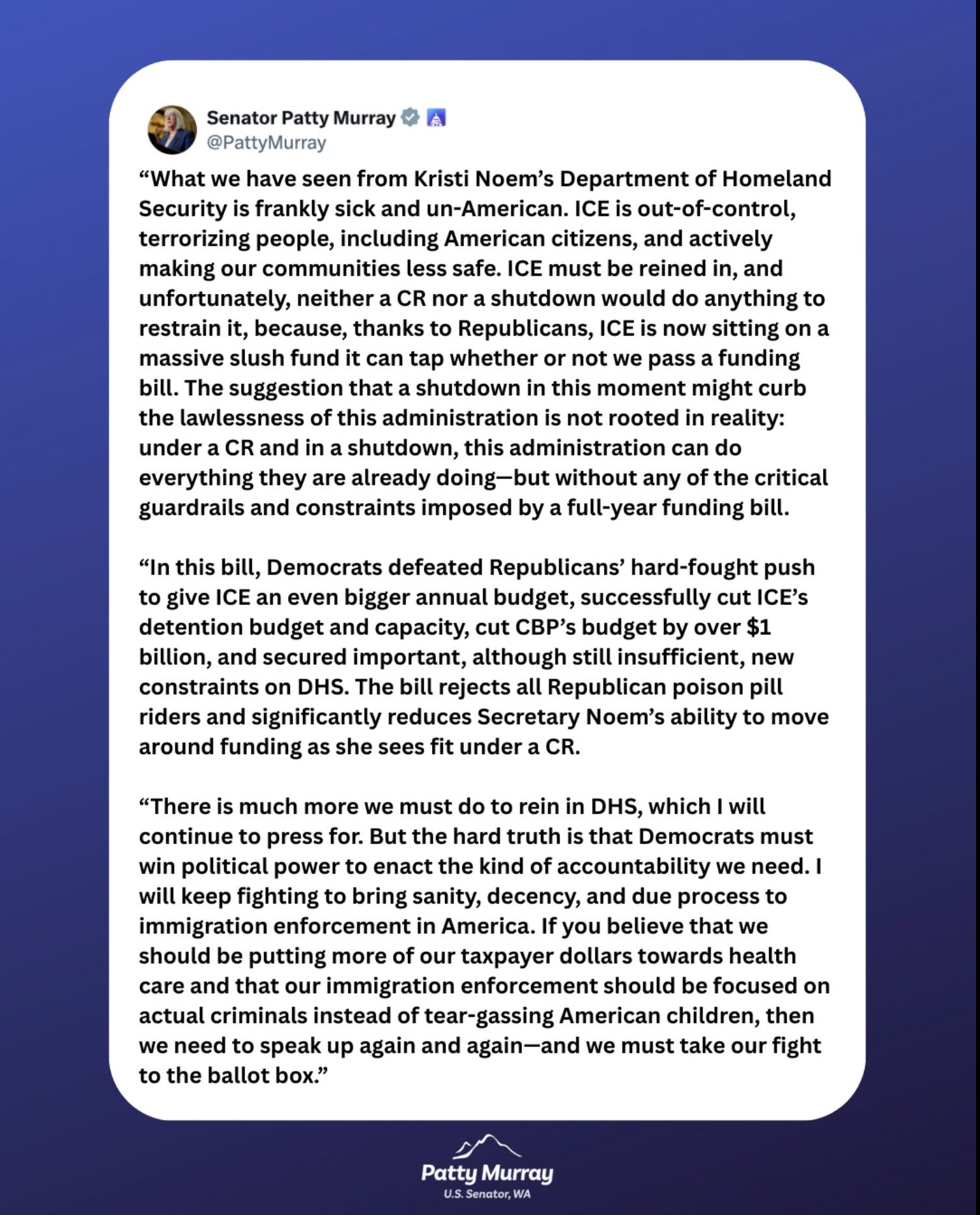
But there doesn’t need to be bipartisan agreement in the House. All that’s needed is 7 Democrats in the Senate for a funding bill to pass. And today we heard from Sen. Patty Murray, the top Democrat on the Senate Appropriations Committee, that there is agreement on DHS funding. She said:
“The suggestion that a shutdown in this moment might curb the lawlessness of this administration is not rooted in reality: Under a [temporary funding bill] and in a shutdown, this administration can do everything they are already doing — but without any of the critical guardrails and constraints imposed by a full-year funding bill.”
Rosa DeLauro, the top dem on the House Appropriations Committee said,
“I understand that many of my Democratic colleagues may be dissatisfied with any bill that funds ICE. I share their frustration with the out-of-control agency. I encourage my colleagues to review the bill and determine what is best for their constituents and communities.
The Homeland Security funding bill is more than just ICE. If we allow a lapse in funding, TSA agents will be forced to work without pay, FEMA assistance could be delayed, and the U.S. Coast Guard will be adversely affected. All while ICE continues functioning without any change in their operations due to $75 billion it received in the One Big Beautiful Bill. A continuing resolution will jettison the guardrails we have secured while ceding authority to President Trump, Stephen Miller, and Secretary Noem.”
According to House Dems:
The bill reduces funding for Immigration and Customs Enforcement (ICE) enforcement and removal operations by $115 million, while keeping the overall budget for the agency flat. Additionally, it reduces the number of ICE detention beds by 5,500, cuts Border Patrol funding by $1.8 billion, and increases oversight through the Office of the Inspector General as well as the Office for Civil Rights and Civil Liberties, which President Trump sought to eliminate last year.
The bill does not include broader reforms proposed by Democrats, including preventing U.S. citizens from being detained or deported and preventing non-ICE personnel from conducting interior enforcement.
The DHS funding bill will go to a vote in the House on an individual basis, but according to Punchbowl’s Jake Sherman, it will be voted on as a package in the Senate.
There are quite a few Senators who really object to this strategy:
-
Sen. Ruben Gallego said, “We cannot vote for anything that actually adds more money and doesn’t constrain ICE…I can’t speak for everybody else, but if I have to shut down the portion of ICE — just to be clear, we’re not shutting down the rest of the government — the portion of ICE that is causing this kind of harm, racially profiling people, terrorizing our cities, I know the implications of that. I know the political implications potentially of that.”
-
Sen. Chris Van Hollen said that he wouldn’t vote to give “one dime to support this lawless, brutal Trump ICE operation,” without “significant reforms to rein in this lawless ICE operation.”
-
Sen. Chris Murphy said, “The proposed Appropriations bill for the Department of Homeland Security released today puts no meaningful constraints on the growing lawlessness of ICE, and increases funding for detention over the last Appropriations bill passed in 2024. I understand Democrats in these negotiations had a hard job – no new budget for DHS is going to cure all the rampant illegality happening within the department. But this bill doesn’t put CBP agents back at the border where they belong and doesn’t put checks on ICE’s out of control arrest and enforcement operations. Democrats have no obligation to support a bill that not only funds the dystopian scenes we are seeing in Minneapolis but will allow DHS to replicate that playbook of brutality in cities all over this country.”